Average Reviews:

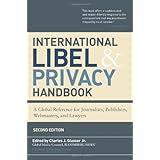
(More customer reviews)Are you looking to buy International Libel and Privacy Handbook: A Global Reference for Journalists, Publishers, Webmasters, and Lawyers, Second Edition? Here is the right place to find the great deals. we can offer discounts of up to 90% on International Libel and Privacy Handbook: A Global Reference for Journalists, Publishers, Webmasters, and Lawyers, Second Edition. Check out the link below:
>> Click Here to See Compare Prices and Get the Best Offers
International Libel and Privacy Handbook: A Global Reference for Journalists, Publishers, Webmasters, and Lawyers, Second Edition ReviewI am an avid subscriber to Seth Godin's blog (http://sethgodin.typepad.com) and am grateful to him for calling my attention to this Second Edition of a book of which I was previously unaware. The material was created by 41 global experts and edited by Charles J. Glasser Jr. who also wrote Chapter11 (on The Middle East with Ava Macalpin), Chapter 20 (on Poland), and Appendix III ("Cross Reference Chart"). Together, Glasser and his colleagues offer a global reference of legal information and counsel for journalists, publishers, webmasters, and lawyers. Their material is divided as follows, with a separate chapter devoted to each country:
Part One Americas (Chapters 1-3: Brazil, Canada, and United States)
Part Two Asia and Australia (Chapters 4-13: Australia, China, Hong Kong, India, Japan, Korea, Malaysia, The Middle East, Singapore, and Thailand)
Part Three Europe (Chapters 14-23: Belgium, England and Wales, France, Germany, Italy, Netherlands, Poland, Russian Federation, Spain, and Switzerland)
Readers will appreciate Glasser's exceptionally informative Preface (Pages xiii-xxiii) in which he explains media law in the global context. As he points out, "There is no single body of `international law' that explains the risks a reporter, editor, or webmaster faces. There is no such unified theory of law in securities litigation or in environmental or health care law3, so why should there be one in publishing?" Glasser cites a number of especially complicated situations that indicate why "media law around the world is a crazy patchwork quilt of laws, with each square reflecting a nation's cultural biases, political history, and economic structure." The situation is complicated, yes, but not hopeless. Glasser suggests that, "if the highest standards of accuracy, clarity, and fairness are met," It should be possible, for example, to publish anything anywhere in the world. He suggests several principles for global publishers to consider: verify and document accuracy of whatever is presented as fact (rather than Rather than "rush to publish"), make fairness an obvious and primary element of all news stories, serve whatever is in the public interest (as opposed to offering what will interest to the public), respect and be sensitive to cultural differences, and don't confuse the right to publish with what's right to publish. "Common sense and good taste will almost never steer you wrong." However, many serious mistakes are the result of ignorance, not intent, and can have costly consequences. Hence the importance of understanding law in the global context. "There's often no single `right' answer, but we have an ethical obligation, as well as a legal one, to ask the right questions."
Indeed, Glasser makes brilliant use of the Q&A format in his Introduction (Pages 1-17), during which he poses and then responds to 21 Key Questions, many (if not most) of which are probably questions that are most frequently asked by those most concerned about libel and/or privacy issues. Variations of the same Q&A format (i.e. pose and then respond to 21 key questions) are also used by other contributors throughout the book. Obviously, each reader will have her or his specific areas of interest and issues of urgency. Readers will also appreciate the four appendices: "Special Issues for Book Publishers," Slade R. Metcalf of Hogan & Hartson LLP; "Shooting Stars: Privacy Claims in the UK, Amber Melville-Brown, David Price Solicitors & Advocates; "Cross Reference Chart" of key issues re 22 countries, Charles J. Glasser Jr., Bloomberg News; and "Recommended Reading."
Because the Contents pages only identify chapter subjects and author(s), I think it would be advisable, after checking them out, to proceed immediately to Glasser's "Cross Reference Chart" of key issues re 22 countries on Page 430. For purposes of illustration, let's say that interest is limited to China, Hong Kong, Japan, and Korea. They are discussed in Part Two, Chapters 5, 6, 8, and 9. Before reading these chapters, it may be helpful to know the similarities and differences between and among these four countries in terms of the 17 attributes that begin with "Truth as Absolute Defense?" and conclude with "Law Applies to Internet?" Note: Glasser's attribute designations for each country are Y = Yes, N = No, U = Unclear, and Q = Qualified or Limited.
This book is not for everyone, of course, but for those who have concerns about international libel and privacy legal issues, I think it is a "must read." Thanks to Charles Glasser and his associates, especially given the scope and complexity of those issues, this book is probably as reader-friendly as it could possibly be.International Libel and Privacy Handbook: A Global Reference for Journalists, Publishers, Webmasters, and Lawyers, Second Edition Overview
Want to learn more information about International Libel and Privacy Handbook: A Global Reference for Journalists, Publishers, Webmasters, and Lawyers, Second Edition?
>> Click Here to See All Customer Reviews & Ratings Now

0 comments:
Post a Comment