Average Reviews:

(More customer reviews)Are you looking to buy Senna Versus Prost: The Story of the Most Deadly Rivalry in Formula One? Here is the right place to find the great deals. we can offer discounts of up to 90% on Senna Versus Prost: The Story of the Most Deadly Rivalry in Formula One. Check out the link below:
>> Click Here to See Compare Prices and Get the Best Offers
Senna Versus Prost: The Story of the Most Deadly Rivalry in Formula One ReviewThe impression it leaves me is that Folley was so delighted and gratified to be given a nice lunch and a fairly in depth interview by Prost in his Paris apartment in 2008 that his efforts to remain impartial thereafter collapsed into a morass of subtle and not so subtle slips that reaffirmed the narrative of Prost as the ultimate gentleman and Senna as the fragile and ruthless newbie who came and stole it all away. As such, the Folley narrative ranges from fair and balanced, to being rantingly anti-Senna. To the extent that Senna's story is told, or his point of view heard in retrospect, it is through the words of the others of the time: Warwick, Brundle, Berger, Walker, Jardine, Leberer et al, who Folley has at least taken the trouble to interview and quote. (Brundle is impressively self-effacing and candid about his standing against Senna...no agenda there. Warwick is also remarkably gracious, as he has been over the years about Senna, who he retains an immense respect for). Meanwhile, Folley's faithful repetition, without the slightest irony, of Prost's claim about Suzuka in '89: "I had no interest to make a crash", is a case in point. This is as disingenuous a statement as we have heard from Alain, up there with his equally laughable claim that he never blocked Senna from the Williams team for 1993 (we all know he did, and Senna called his bluff with his 'I'll drive for free' offer to Williams, to make the point). But the narrative treats it without the slightest scepticism, having described the Suzuka collision simply as "a brash manoeuvre" on Senna's part, which "hopelessly misjudged Prost's mood". Never mind that Prost's block is regarded quite widely in the F1 pitlane as the template professional foul, as premeditated as they come, and that attempting to pass someone going more slowly than you is usually regarded as one of the primary imperatives of motor racing. Instead, Alain's 'mood' is what counts. Needless to say, there are valid criticisms to be made of Senna's career and conduct. What is lost in this book is the notion that Prost had a ruthless and underhand streak, too, and was something other than a serial victim.A good example of what I mean when I say Folley's narrative varies from level headed to openly ranting against Senna, comes at the conclusion of a passage quoting Senna about the notorious incident at Imola in `89, where Prost accused Senna of reneging on an agreement to not attack each other at the first turn after the race start. Here, Folley quotes Senna:
"On the second start, after Berger's accident, he got off to a better start than me. But I got in his slipstream and accelerated quickly. I was going faster than him. I then started the manoeuvre to overtake him. Not at the first corner, before that. It was when we were braking that we were not to attack each other. We had a momentary confrontation, and then I drove clear. He made a mistake and skidded off the track. He had made a driving mistake, but he was trying to make me take the blame. The original idea was simple: no overtaking as we braked on the first bend. After the race, I had a clear conscience. I didn't think that the whole thing would take on such proportions".
So far, so good. Folley is quoting Senna's point of view, and we have already heard Prost's point of view, at great length over several pages. But here's how Folley goes on, and, to be clear, this is our author talking, not Alain Prost:
Folley: Perhaps that had something to do with the fact that he had not been in the race when Pironi, blatantly, and inexcusably, betrayed the promise he had shared with Villeneuve. Perhaps that had something to do with the fact that Prost had lived with that haunting memory for seven years and knew it would never leave him. What was it Prost said? "Gilles was angry with Pironi and Ferrari, absolutely furious. Later I would fully understand these feelings because I had this with Ayrton. At the next race, Gilles went too far in the car in practice. He killed himself because of that dispute with Didier." Do you really believe that drivers would enter a pact that involved no overtaking before a braking area rather than a more specific location, such as the first corner?
So here we have Folley pouring scorn on Senna's account and using the passive aggressive, if not openly sarcastic "perhaps that had something to do with..." language to frame the narrative in terms of Prost's feelings about it. All that's missing is the jabbing of the author's finger at Senna's chest (Folley even addresses the reader in the first person, as if we're incredibly dumb to have even entertained Senna's side of the story all these years). Not for the first time, we hear that Senna should somehow have been cognisant that his rival's buried feelings over an accident 7 years earlier, before Senna even entered F1, would be triggered, along with the displaced fury that went with them. It's an interesting idea, that F1 drivers should be aware of all the experiences and traumas their rivals have been through, take account of them and act accordingly. This is not to say that there is no argument that Senna did wrong, though I find it tenuous at best to invoke the events of 1982 as the primary determinant of the rights and wrongs of a passing move in 1989, but the whole passage from Folley reads to me like an outburst, more like something you'd read from a partisan poster on an internet forum than something you'd read in book, written by a professional author, billing itself as an impartial account of a rivalry. Senna could be fully in the wrong on this and the point would still stand. This is not balanced writing, it is a framed narrative from someone who either began the exercise as a firm fan of Alain Prost, or became one through his interviews with the man.
The Villeneuve/ Pironi narrative (not only their clash at Imola and Villeneuve's death at Zolder, but also Prost's involvement in Pironi's crash at Hockenheim), which legitimately altered Prost's outlook on risk, runs like a thread through the book. This is interesting, but it's woven through the story in such a way that it's clear Folley thinks it is directly relevant to Senna's own penchant for risk. It would have been better to note the point and move on, rather than keep bringing it up every time Senna is seen to challenge Prost on the circuit. And Pironi's crash always was a feeble excuse for Prost's dire performance at Silverstone in '88, but trotted out here nonetheless.
More pro-Prost sympathies are in evidence when we hear, to take one example, that he had niggling clutch problems at the WDC decider in the wet in Suzuka in '88. A detail worth noting? Well, sure, even if it's the first I've heard of it in the intervening 22 years. But driving around minor mechanical issues was par for the course at the time and where is the mention of, say, Senna's pop-off valve malfunctioning in Mexico earlier the same year, and limiting his boost (a race which the book just blandly notes was won easily by Alain, with, quote: "a flawless drive")? If one is worth a mention, then so is the other, but the race accounts are generally bereft of such detail and it creates a false impression.
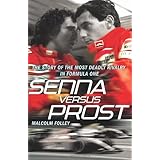
The cover was designed by an idiot: a picture of Prost & Mansell? on the front, and Derek Warrick (sic) is mis-spelled on the rear cover. There are factual gaffes: for example stating that Watson never raced an F1 car again after 1983. Actually he raced the McLaren in '85 after Lauda hurt his wrist, and made comments about how he knew his career was over when he witnessed Senna at Dingle Dell on a qualifying lap (Watson was on an in lap at the time) - an episode that might actually have served the narrative had Folley been aware of it.
It is also somewhat repetitive. How many times do I need to be told the list of greats who have won Monaco?
Early in the interview, Prost had noted that he knows he can't compete with the ghost of Senna, the legacy of a dead hero. As such, this is a book that might actually plug a legitimate market gap because I doubt that Prost's point of view, laughably self-serving though it is, has been aired as fully as the Senna plaudits have aired the legend of the brilliant Brazilian. Had the book been called "Prost's point of view: a rivalry with Senna", or some such, I would welcome it, as written. Unfortunately it is billed as a fair account, and the flipside of Prost's dilemma is that Senna is no longer around to defend himself at all. As such, and fascinating as it will always be to hear his reminiscences, it almost seems like a cheap shot from Prost to have been behind this book in such a way. The final responsibility, though, lies with the author.Senna Versus Prost: The Story of the Most Deadly Rivalry in Formula One OverviewIn the late 1980s and early 1990s, Formula One was at its most explosive, with thrilling races, charismatic drivers, nail-biting climaxes—andone of the most dangerousrivalries ever witnessed in sports. Two of F1's most honored champions and iconic figures drove together for McLaren for two seasons, and their acrimonious and hostile relationship extended even after one of them had left the team. Alain Prost was France's only F1 world champion,an intelligent, smooth driver with the epithet "Le Professeur,"while Ayrton Senna wasthe mercurial kid from a privileged background in Sao Paolo who would become the most intense and ruthless racing driver the world has ever seen. As the great rivals raced to victory, their relationship deteriorated badly, culminating in Prost accusing Senna of deliberately trying to ride him off the circuit, and fearful that the Brazilian would get someone killed with his daring overtaking feats. The final, sad act of this drama happened at the San Marino Grand prix at Imola in May 1994, when Senna was killed.Insights from Martin Brundle, Damon Hill, Sir Frank Williams, Bernie Ecclestone, Derek Warrick, Johnny Herbert, Gerhard Berger, plus McLaren insiders and other F1 figures provideus with a breathtaking account of one of the all-time classic sporting rivalries.
Want to learn more information about Senna Versus Prost: The Story of the Most Deadly Rivalry in Formula One?
>> Click Here to See All Customer Reviews & Ratings Now

0 comments:
Post a Comment